

.jpg)
.jpg)
.jpg)
.jpg)
.jpg)


.jpg)

CEO's Stories: Dr. Swapnil Sinha — Building an Innovation Ecosystem for Northeast India
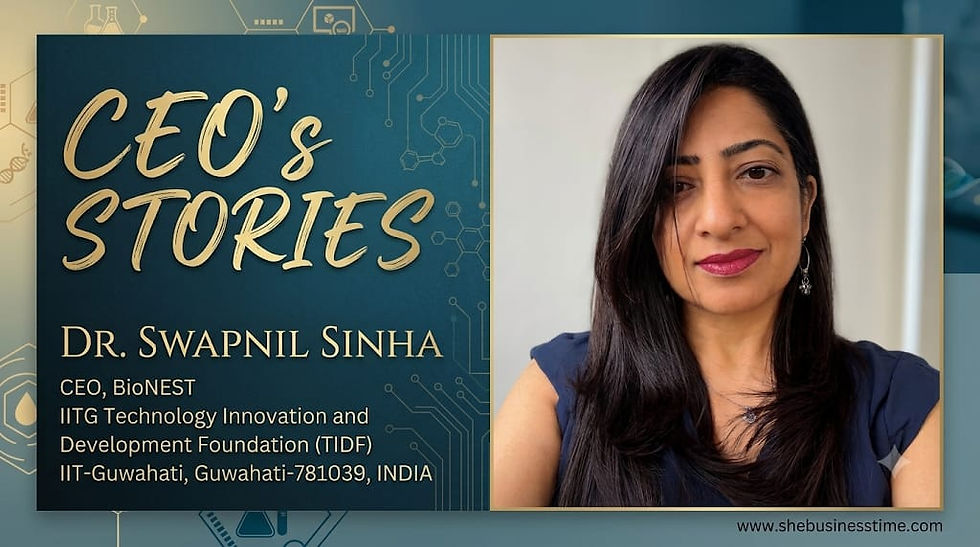
In India’s rapidly evolving innovation landscape, the journey from scientific discovery to a market-ready solution is often filled with challenges. For Dr. Swapnil Sinha, CEO of IIT Guwahati BioNEST, leadership is about building the ecosystem that helps researchers and entrepreneurs cross that gap.
A biomedical scientist by training and an innovation ecosystem leader by profession, Dr. Sinha brings more than 15 years of experience across scientific research, biotechnology, entrepreneurship, incubation and technology translation. Her journey reflects a powerful shift—from creating knowledge as a scientist to enabling others to transform knowledge into businesses, jobs and societal impact.
What happens when a scientist decides that creating knowledge is only the beginning—and that the real impact lies in helping others transform ideas into products, companies and social impact?
For Dr. Swapnil Sinha, CEO of IIT Guwahati BioNEST, the answer has been a remarkable journey from scientific research and biotechnology to entrepreneurship, startup incubation and innovation ecosystem building.
With over 15 years of experience spanning scientific research, genomics, biotechnology, entrepreneurship, technology translation and incubation, Dr. Sinha is helping build a stronger innovation ecosystem for Northeast India.
IIT Guwahati BioNEST has supported more than 95 startups, helping entrepreneurs move from ideas and technologies towards validation, commercialisation and scale.
In this edition of CEO Stories by She Business Time, Dr. Swapnil Sinha shares her leadership journey, lessons from entrepreneurship, her vision for Northeast India's innovation ecosystem, the future of AI and biotechnology, and her message to young women aspiring to become entrepreneurs and CEOs.
Q1. Please introduce yourself and your organisation.
Dr. Swapnil Sinha:
I am Dr. Swapnil Sinha, a biomedical scientist by education and an innovation ecosystem leader by profession, currently serving as the CEO of IIT Guwahati BioNEST.
My journey has taken me from scientific research and biotechnology to building and enabling technology-driven startups.
IIT Guwahati BioNEST is an innovation and incubation platform supported by IIT Guwahati, focused on translating science and technology into enterprises. We work with startups across healthcare, agritech, defence and aerospace, cleantech, food and biomanufacturing, with a particular focus on creating opportunities for entrepreneurs from Northeast India.
Since our inception, we have supported more than 95 startups, facilitated funding for several ventures and helped founders move from ideas and technologies towards validation, commercialisation and scale. We are proud to be the leading bio-incubator of Northeast India.
Q2. What inspired you to become an entrepreneur or CEO?
Dr. Swapnil Sinha:
Interestingly, I did not begin my career with the ambition of becoming a CEO. I began as a scientist.
I started my research in genomics and worked in three countries with a research focus on genomics and synthetic biology. Over time, I realised that creating knowledge is only one part of the innovation journey. The larger challenge is converting that knowledge into products, companies, jobs and societal impact.
I started my first startup in 2018, where we were developing DNA biosensors in collaboration with IIT Guwahati for bacterial disease diagnosis.
Later, I realised that I could be a very good ecosystem builder, focused on developing technology innovation and translating it into market-viable products.
That realisation gradually moved me from being a researcher to becoming an enabler of researchers and entrepreneurs.
Today, I see my role less as running an organisation and more as creating an environment in which other people can build something meaningful.
Q3. What has been the defining moment in your leadership journey?
Dr. Swapnil Sinha:
The defining moment in my leadership journey was when I realised that my greatest impact would not come from what I could achieve personally, but from what I could enable others to achieve.
Nothing gives me greater satisfaction than seeing a young founder walk into our ecosystem with an idea in their eyes, struggle through uncertainty and eventually build something that creates value, livelihoods and hope.
There have been moments when a founder has come back and said, “You believed in us when we were still trying to believe in ourselves.”
Those moments stay with me.
If a conversation with me gives someone courage to take the next step, if a platform I build helps a young entrepreneur create jobs, or if an idea that might otherwise have remained inside a laboratory reaches someone who genuinely needs it—that, to me, is leadership.
For me, impact is the legacy I want to leave behind.
Q4. What is the vision behind IIT Guwahati BioNEST?
Dr. Swapnil Sinha:
Our vision is to make innovation commercially and socially relevant, particularly for Northeast India.
The Northeast has enormous biodiversity, scientific talent and entrepreneurial potential, but there are gaps in infrastructure, capital, market access and technology translation.
IIT Guwahati, being the premier institute in the region, can help bridge those gaps and position the region not merely as a consumer of innovation, but as a creator and manufacturer of innovative products.
Our larger ambition is to build an ecosystem where a scientist or entrepreneur in the Northeast can take an idea from the laboratory to the market without having to leave the region.
This ultimately opens avenues for both job seekers and job creators, resulting in employment generation, livelihoods and deep social impact.
Q5. What leadership values guide your decisions every day?
Dr. Swapnil Sinha:
Three values guide me strongly: integrity, ownership and impact.
Integrity means doing the right thing even when nobody is watching.
Ownership means taking responsibility rather than looking for someone to blame.
And impact means constantly asking whether what we are doing is actually creating value and touching lives.
I also believe strongly in empathy. When I first joined BioNEST, it took me a while to understand the region and the founder mindset, especially the human component.
Behind every startup is a founder taking a personal and professional risk. As ecosystem leaders, we have to understand that human dimension.
Q6. How do you build and motivate high-performing teams?
Dr. Swapnil Sinha:
I believe high-performing teams are built around trust, autonomy and purpose.
People perform at their best when they understand why their work matters and are given enough ownership to make decisions.
I try to create an environment where people are encouraged to take responsibility, experiment and even fail—as long as they learn and remain accountable.
I also believe that a leader's job is to create more leaders, not more followers.
I have a quote from Steve Jobs printed in my office:
“Have the courage to follow your heart and intuition.”
I always ask my employees and founders to understand the deeper meaning behind it, especially during adversity.
Q7. What were the biggest challenges you faced while building the innovation ecosystem?
Dr. Swapnil Sinha:
Building an innovation ecosystem is fundamentally different from building a conventional business.
The outcomes are often long-term, uncertain and difficult to measure.
One of the biggest challenges has been bringing together different stakeholders—scientists, entrepreneurs, investors, government agencies, corporates and academia—who often operate with very different priorities, bandwidth and timelines.
We addressed this by building partnerships rather than trying to do everything ourselves.
Today, our work involves government programmes, CSR partnerships, investors, academic institutions and industry.
The lesson has been simple:
Ecosystems cannot be built overnight. They are cultivated through patience, trust and consistent support.
Q8. What achievement are you most proud of as a CEO?
Dr. Swapnil Sinha:
I am proudest of the “Enabler Ecosystem” we have helped create at IIT Guwahati BioNEST.
We have supported more than 95 startups and created multiple programmes for entrepreneurs across Northeast India.
Through initiatives such as NEC-Ignite, we have supported around 52 startups across the Northeast, helped technologies move towards commercialisation and created pathways for entrepreneurs who may otherwise have had limited access to capital and infrastructure.
But beyond the numbers, I am most proud when a founder tells me:
“We would not have been able to do this without your support.”
That is probably the most meaningful KPI for an incubator CEO.
Q9. Can you share a failure or setback that taught you an important lesson?
Dr. Swapnil Sinha:
One lesson I have learned is that not every good technology becomes a good business.
In the early years, it is easy to become excited by scientific novelty. But technology alone is not enough.
There has to be a clear customer, a compelling value proposition, a regulatory pathway, a scalable business model and the ability to execute.
Today, I encourage founders to ask difficult questions much earlier:
Who will pay? Why will they pay? Can we manufacture at scale? Can we survive regulatory and market barriers?
Sometimes the best leadership decision is to stop pursuing an attractive idea before it consumes too much time and capital.
Q10. How is IIT Guwahati BioNEST adapting to changing technology and market trends?
Dr. Swapnil Sinha:
We are increasingly working at the intersection of biotechnology, AI, deep tech, advanced manufacturing and sustainability.
AI, for example, is changing healthcare, drug discovery, diagnostics, agriculture and industrial processes.
Similarly, biotechnology is moving beyond laboratories into food, materials, climate solutions and manufacturing.
Our role as an incubator is to ensure that startups have access not only to physical infrastructure, but also to emerging technologies, mentors, investors, regulatory expertise and markets.
Q11. What role does innovation play in your strategy?
Dr. Swapnil Sinha:
Innovation is not a separate activity for us—it is the foundation of what we do.
Our objective is to identify emerging technologies and create pathways for them to become commercially viable solutions.
Increasingly, I believe innovation should be measured not by the number of patents or prototypes created, but by how effectively those innovations reach society.
The journey from lab to market is where much of India's innovation potential still remains untapped.
Q12. Where do you see IIT Guwahati BioNEST in the next five years?
Dr. Swapnil Sinha:
I see IIT Guwahati BioNEST evolving from an incubation centre into a much larger regional innovation and technology-commercialisation platform.
I would like to see the Northeast emerge as a hub for:
Bio-manufacturing
Sustainable technologies
Healthcare innovation
Functional foods
Agritech
Climate-oriented enterprises
Our ambition is to help create companies that are not only locally relevant but nationally and globally competitive.
Q13. What are the biggest opportunities and challenges for women leaders today?
Dr. Swapnil Sinha:
There is an enormous opportunity because the entrepreneurial ecosystem is becoming more diverse and more receptive to women-led businesses.
However, women entrepreneurs still face challenges related to access to capital, networks, mentorship, market opportunities and sometimes social expectations around leadership and risk-taking.
The answer is not simply to create more women-focused programmes.
We need to create an ecosystem where women entrepreneurs have equal access to capital, technology, customers, mentors and decision-making spaces.
Q14. How can organisations create more inclusive workplaces for women?
Dr. Swapnil Sinha:
Inclusion has to go beyond policies written on paper.
Organisations need transparent growth opportunities, equal pay, flexible working structures where appropriate, safe workplaces, strong mentorship and zero tolerance for discrimination or harassment.
Most importantly, women should be evaluated on their competence and performance—not through assumptions about what they can or cannot take on.
Q15. What advice would you give to young women aspiring to become entrepreneurs or CEOs?
Dr. Swapnil Sinha:
Do not wait until you “feel” completely ready.
Entrepreneurship is inherently uncertain and leadership is learned through experience.
Build expertise. Develop financial and business literacy. Find mentors. Surround yourself with people who challenge your thinking.
Most importantly, develop the confidence to make decisions.
I would also say: don't confuse being liked with being a good leader. A good leader has to make difficult decisions, communicate clearly and take responsibility for outcomes.
Q16. How do you maintain work-life balance?
Dr. Swapnil Sinha:
I have gradually realised that balance is not about dividing every day equally between work and personal life.
It is about being fully present in whichever role you are playing at that moment.
My work can be demanding, but I try to create space for things that keep me grounded—my son, reading and blogging, cycling and occasionally simply stepping away from the intensity of work.
I also believe that leaders need periods of reflection.
Constant activity does not necessarily mean productivity.
Q17. Who has been your biggest mentor or source of inspiration?
Dr. Swapnil Sinha:
I have been fortunate to have several people who have shaped different dimensions of my journey.
My biggest professional mentor has been my PhD supervisor, Dr. Saman Habib. From her, I learned much more than science. She taught me what it means to be a perfect professional—to be disciplined, resilient, ethical, confident and uncompromising about the quality of your work.
Prof. Dipankar Bandyopadhyay of IIT Guwahati has also played a defining role in my journey at IIT Guwahati BioNEST. His faith in my abilities and encouragement have been deeply significant.
My mother, who herself was a professor, has been a constant source of inspiration. From her, I learned the value of education, independence, perseverance and the dignity of building one's own identity through one's work.
And then there is my son. He is not a professional mentor, but he is perhaps my biggest emotional anchor.
Q18. Which book, quote or life philosophy has influenced your leadership?
Dr. Swapnil Sinha:
A few books and philosophies have influenced me at different stages.
The 48 Laws of Power taught me to understand human behaviour, power dynamics and the importance of being strategic in leadership.
Shoe Dog by Phil Knight reminded me that behind every successful organisation is a deeply human journey filled with uncertainty, failures, self-doubt, persistence and courage.
I am also deeply inspired by Chanakya's philosophy of leadership and statecraft, particularly the idea that a leader's responsibility is not to seek power for oneself, but to create an environment in which people and institutions can prosper.
And one quote that has stayed with me is Steve Jobs' “Stay hungry. Stay foolish.”
To me, it is a reminder never to become complacent with what we have already achieved.
My own leadership philosophy has therefore become quite simple:
Stay curious. Stay grounded. Keep learning, and never stop creating impact.
Because ultimately, leadership is not about how high you rise; it is about how many lives you can touch while you are there.
Dr. Swapnil Sinha: A CEO Building More Than Startups
Dr. Swapnil Sinha's journey demonstrates that leadership can take many forms. For her, being a CEO is not simply about managing an organisation—it is about creating an environment where scientists, founders and innovators can turn possibilities into impact.
Her work at IIT Guwahati BioNEST reflects an important opportunity for Northeast India: building the infrastructure, partnerships, capital pathways and entrepreneurial confidence required to transform regional scientific talent into globally competitive enterprises.
Her message is equally relevant to today's emerging women leaders: do not wait to feel ready, take ownership, build expertise, make decisions and keep creating impact.
About CEO Stories by She Business Time
CEO's Stories by She Business Time celebrates visionary leaders who are shaping businesses, industries, communities and the future of India. Through authentic conversations, the series brings forward leadership journeys, entrepreneurial lessons, innovation stories and insights from changemakers who are creating meaningful impact.


Comments